Porch note
Condensation Along the Door Line
A seal fails slowly and invisibly. Long before it lets go, it is letting in humid air, and the cabinet is paying for it in compressor hours.
5 min read doors and seals
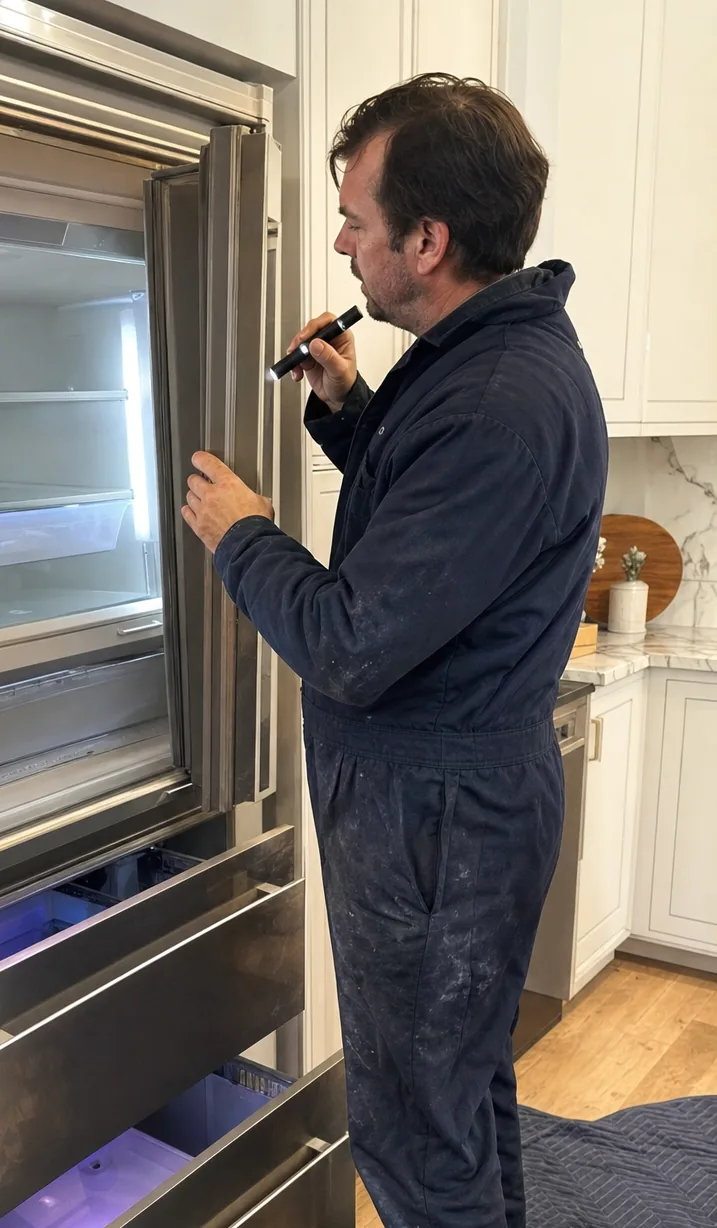
A door seal does not fail the way a part fails. It does not stop working one morning. It takes a set where it has been compressed, loses spring at the corners, and then spends a year or two being almost good enough — which is precisely the condition that costs you money without ever announcing itself.
The first visible symptom is usually condensation. Water on the outside edge of a panel, a damp line along the cabinetry beside the door, or a light frost just inside on the first cold surface. In Mandarin, where the dew point stays high from June into September, you will see it in summer and not in January, which often leads people to conclude it is normal for the season. Some of it is. Persistent condensation is not.
How to check a seal properly
Three checks, none of which need tools.
Run a hand along the whole gasket. Not one corner — the whole run, on a humid day, with the door closed and the cabinet cold. A stretch that feels noticeably cooler and damper than the rest is where air is passing.
Look at the reveal. On an integrated column or a panelled built-in, the gap between the door panel and the surrounding cabinetry should be even top to bottom and side to side. It was even the day it was installed. If it is not even now, the door has moved, and a door that has moved is loading the gasket unevenly.
Watch the door close on its own. From a few inches open it should draw itself shut and settle. A door that hangs at the last inch, or bounces slightly and stays proud, is not making full contact.
Why it matters more than it looks
Air that gets past a seal is warm and, here, wet. Two things follow. The compressor runs longer, because it is now cooling the kitchen through a gap. And the moisture in that air condenses inside the cabinet, which is where frost on a back wall or ice around a drawer comes from.
On wine storage the consequence is different and worse. A wine cabinet is supposed to hold humidity within a range that keeps a cork swollen. When the seal is imperfect, the cabinet follows the room instead — and a Mandarin house is air-conditioned dry for eight months of the year. The first symptom there is not condensation at all. It is corks drying out, which nobody notices until they open something.
The cabinetry is the other reason to act early
Panelled units are trimmed into joinery that frequently costs more than the appliance. Water running down the outside of a panel edge, week after week through a Florida summer, ends up in the veneer, in the substrate and in the finish. Replacing a gasket is a modest job. Replacing a custom panel is not.
What actually gets fixed
Often nothing needs replacing. A door that has drifted can usually be brought back to true at the hinge, and a gasket that is dirty rather than tired will seal again once it is cleaned properly — old gaskets pick up a film that stops them from releasing and re-seating cleanly.
Where the gasket has genuinely taken a set, it is replaced with a genuine OEM part, and the door is realigned at the same time, because fitting a new gasket to a door that is out of true just starts the clock again.
If you are seeing condensation, look at the reveal first and tell us what you find. It is the single most useful thing you can observe before we arrive, and it frequently determines whether the visit needs a part on the van at all.
What it costs
What does putting this right cost?
The bands that fit what this note is about. The diagnostic comes first and is credited toward the repair.
| What is being put right | Parts and labour |
|---|---|
| Diagnostic visit | $80 flat, credited toward the repair |
| Door gasket or seal replacement | $240–$620 parts and labour, after the diagnostic |
Every line above is a range because the firm figure is written down after the diagnosis and not before it. The $80 covers coming out, testing the system and telling you what is wrong, and it comes off the repair the moment you say go ahead. The whole table, and what happens when a repair is not worth doing, is on the what it costs page.
If this is your fault
The repair page for it
- Sub-Zero integrated column: door out of true, drawers icing Panel-ready refrigerator and freezer columns that sit flush with the cabinetry until something moves, ices up or stops responding.
- Sub-Zero undercounter and drawers running warm in the afternoon The small units in islands, bars and outdoor kitchens, where heat, tight clearance and a long run from the main cabinet make life hard.
- Sub-Zero wine storage: zones drifting apart, humidity falling Dual-zone units where the two compartments have stopped agreeing, humidity has drifted, or the fan has become audible from across the room.
Where this comes up
- Beauclerc The northern end of Mandarin along the San Jose Boulevard corridor, where 1960s and 1970s kitchens were never sized for a modern built-in.
- Julington Creek and Julington Hills The southern edge of Duval County, where newer kitchens were designed around built-in refrigeration and often carry three or four separate cold appliances.
All of the porch notes are listed on the reading page.
These notes are about cold: Sub-Zero refrigeration in Mandarin kitchens. Where one of them mentions a room being air conditioned, or a storm taking the power out, it is describing the conditions the cabinet works in. Loretto Cold Service does not service heating, air conditioning or ductwork and does not install them.
Questions we are asked
What readers ask after this one
- How do I tell whether a door seal has actually failed?
- Watch how it behaves rather than how it looks. A gasket that no longer springs back after being pressed, or a door that lands unevenly along one edge, is letting humid air in long before there is a visible gap. Water on a panel edge is a late sign, not an early one.
- Is condensation along the door line only a cosmetic problem?
- No. It is humid room air arriving inside a cold cabinet, which the appliance then has to remove, and on a wine unit the first symptom is dry corks rather than water at all. There is also the cabinetry: a panel edge that stays wet is the expensive part of ignoring it.
Customer reviews
Owners who called about something like this
Three of the pool, chosen by this page and printed in full.
4.64.6 out of 5 across all 64 reviews published on this site
5 out of 5
The refrigerator column kept alarming an hour after the weekly shop and never otherwise. He put that down to warm air going in all at once rather than a fault, and showed me it recovering normally.
Lysander B.September 2026
5 out of 5
An alarm kept sounding with the door plainly shut. He found the door out of true by a small amount at one corner, brought it back square, and the alarm has not sounded since.
Delphine E.April 2026
4 out of 5
Ice was building around the drawers inside the freezer column. The vent port feeding the stack was blocked. He cleared it, checked how the door landed, and told me what to watch for next summer.
Tobias C.May 2026
A wider selection, three-star entries first, is on the reviews page. All 64 are published across this site, beside the repair or the street each one came from.